Background
A federal republic of 36 states and the Federal Capital Territory, Nigeria is the most populous country in Africa. The state is made up of 250 ethnic groups, the largest of which are the Hausa, Igbo, Yoruba and Fulani. Over 500 languages are spoken, with English the official language.
Key dates
- 1914: The British colonial power consolidates its northern and southern territories in a single entity, ushering in the modern state.
- 1960: Nigeria becomes a formally independent federation.
- 1967 –1970: Civil war breaks out after the Eastern Region declared independence and founded the Republic of Biafra.
- 1999: Democratic elections mark the end of military rule.
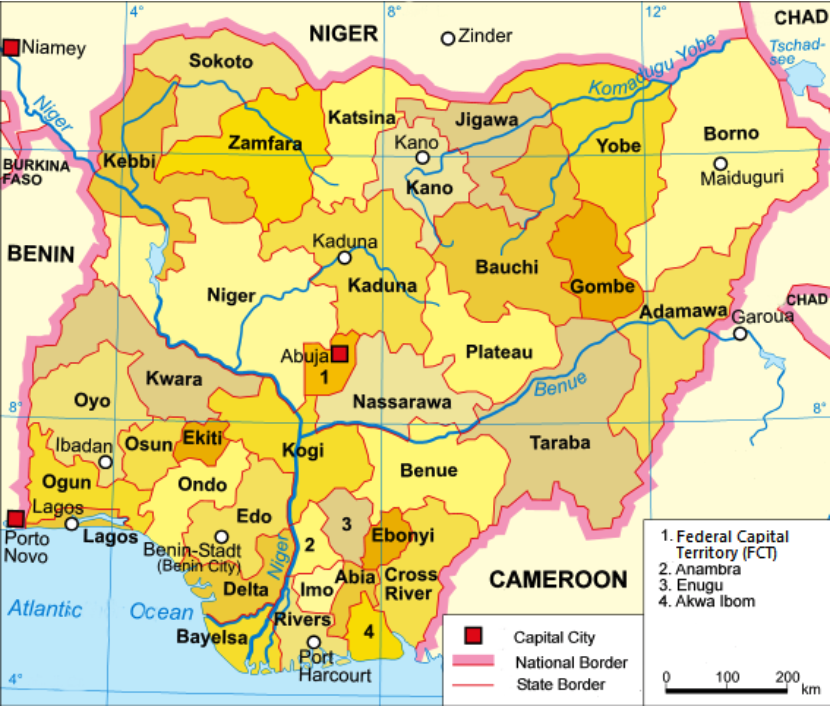
Officially a secular democratic country, Nigeria is one of a handful of non-Muslim majority countries to belong to the Organisation of Islamic Cooperation (OIC), which describes itself as the “collective voice of the Muslim world”.
Ethnic groups and Religion
The population of 203 million is approximately 49% Christian and 49% Muslim. The north of the country is predominantly Muslim while the southern states are mainly Christian. A minority of the population practise traditional religions.
The majority Muslim ethnic groups are the Hausa, Fulani and Kanuri. The vast majority of Muslims are Sunni but there is also a significant Shi’ite minority. Islam has experienced a resurgence. Nine northern states have incorporated Sharia law into their previously secular legal systems since 1999 while three have instituted it in part.
The Christians are roughly three-quarters Protestant and one quarter Catholic. Mostly Christian peoples include the Igbo and Ijaw.
Politics
Executive power is exercised by the president who is both the head of state and of government. The current president is Muhammadu Buhari, a Muslim and Fulani.
The two major political parties are the centre-right People’s Democratic Party of Nigeria (PDP) and the centre-left All Progressives Congress (APC). The APC won the last general election in 2015 and is the party of President Buhari. The next general election will be held in February 2019, when Buhari will seek a second term. Given that the country is in the grip of conflict, security is likely to be a key campaign theme.